Artistic screenprinting: technique, colour and editions
Screenprinting transfers ink through open areas of a mesh onto a support; blocked areas prevent its passage. The process can build an image through colour fields and distinct lines, while also allowing gradations and textures.
Lorenzo González Sánchez’s Mujeres series shows how this language organises a figure. In Sara and Cayetana, lines and coloured areas perform different tasks: defining a face, sustaining a body or extending a background. The technique matters both as a printing process and for the visual possibilities it offers.
How a screen works
A frame holds stretched mesh. Selected areas are blocked, leaving openings through which a squeegee pushes ink onto paper or another support. MoMA’s What Is a Print? explains this process and discusses the medium’s flat colour and clear edges.
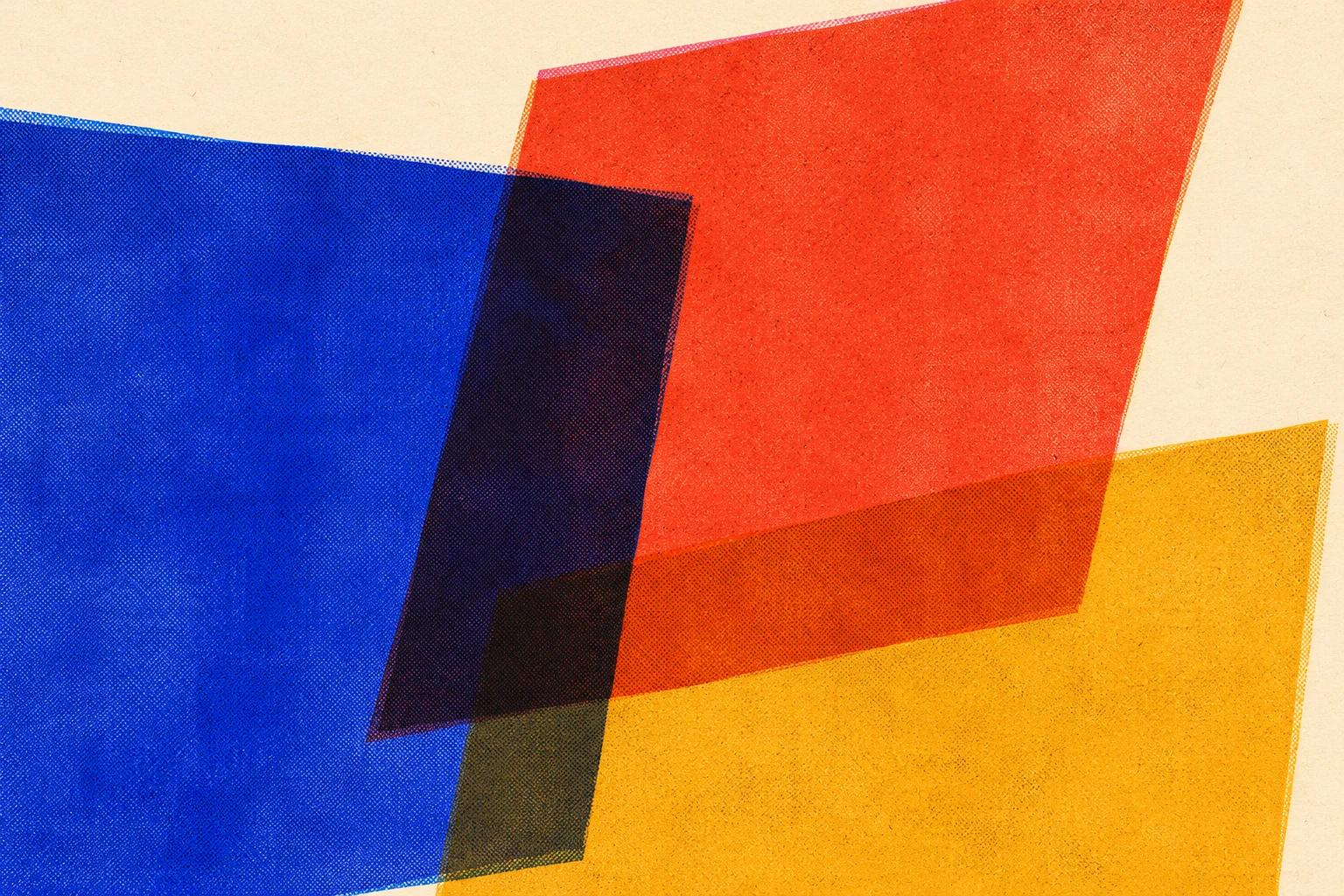
When several passes build an image, registration positions each impression relative to earlier ones. Displacement can create doubled edges, gaps or altered meetings between colours. Accurate alignment contributes to the result, although artists may also use misregistration deliberately.
This general explanation must be separated from knowledge of a particular print. A reproduction alone cannot disclose the number of screens, printing sequence, ink formulation or mesh preparation. Such information requires workshop documentation.
Colour fields and drawn lines
A flat colour area can define a figure without modelling volume through gradual shading. A line can specify eyes, hands or folds. The two need not coincide throughout: colour may extend beyond the drawn contour.
When one field crosses face, arm and background, its function exceeds the depiction of local skin colour. It also connects areas of the sheet and distributes surfaces. The recognised body and the field containing it remain in a visible tension.
Flat colour describes an appearance, not a technique. Paintings, digital prints and screenprints may all contain uniform areas. Catalogue information and examination of the physical work complement what a screen displays.
Sara: arm and head within yellow
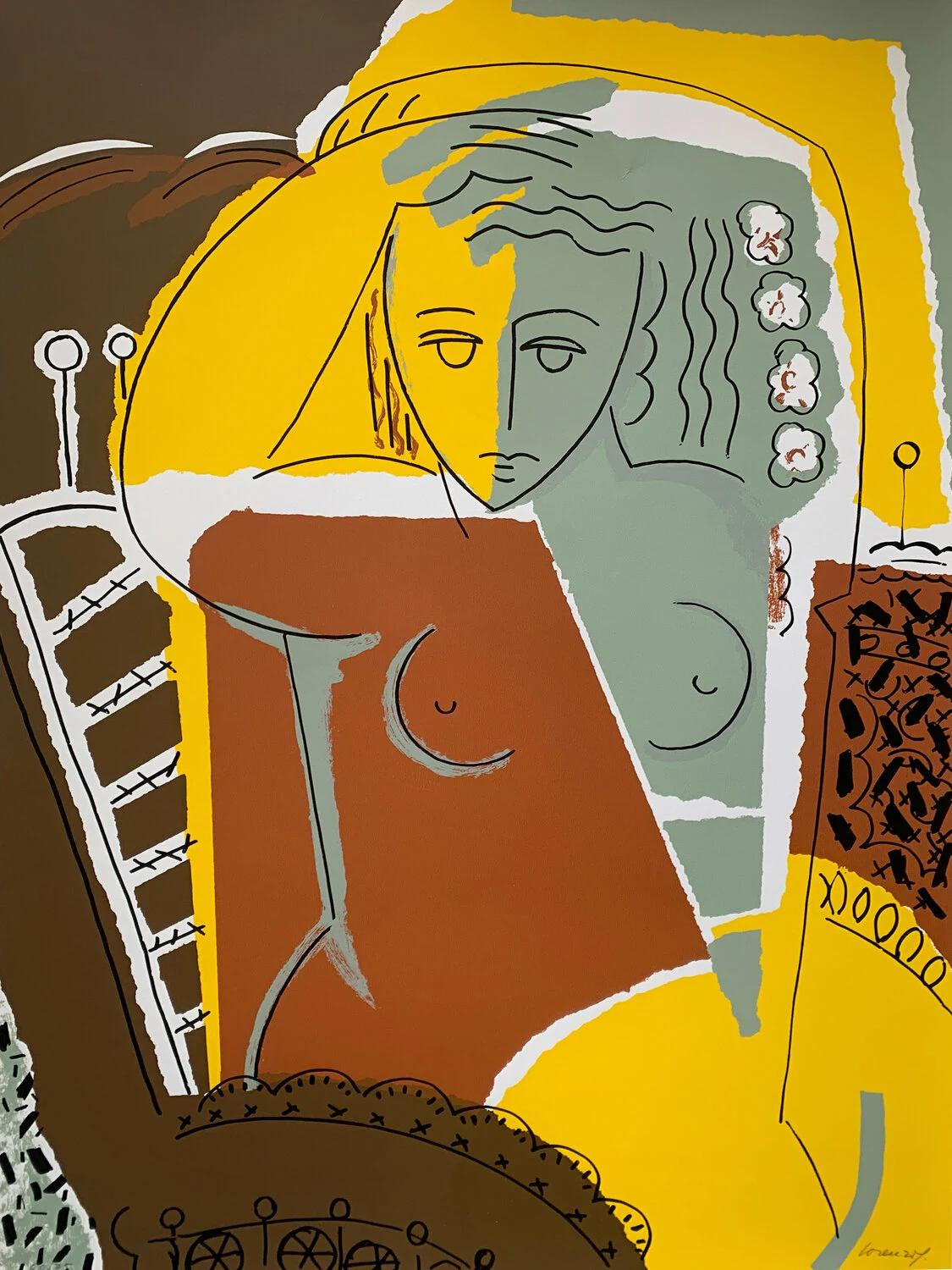
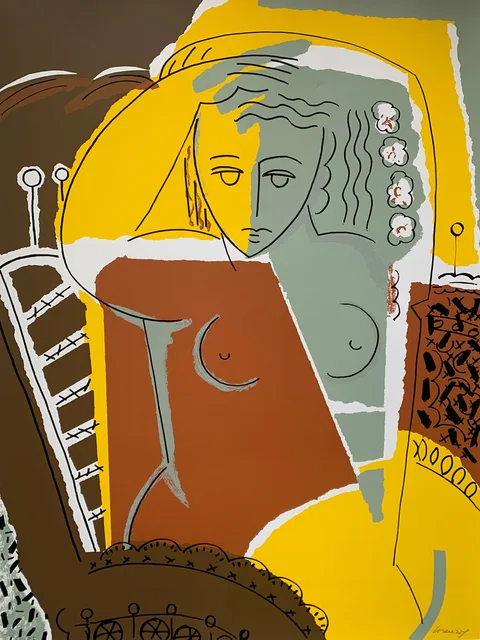
In Sara, a front-facing figure raises one arm above her head. Yellow extends across the arm and part of the face; a grey-green area occupies the other side. A thin black line defines features and continues along the body.
White flowers in the hair introduce a short vertical repetition. On the left, the chair-back lines and light gaps contrast with the torso’s broad surfaces. Dense black marks occupy a narrower area near the right edge.
Eyes, nose, mouth, breast curve and raised arm provide economical cues to the figure. The colour field extends beyond several of these details. Their different scales let us perceive both the figure and the sheet’s overall organisation.
The artist’s catalogue identifies Sara as a screenprint in the Mujeres series, measuring 100 × 70 cm, in an edition of 75 numbered and signed impressions. These details come from the record, not an estimate from the photograph.
Cayetana: a light line on orange
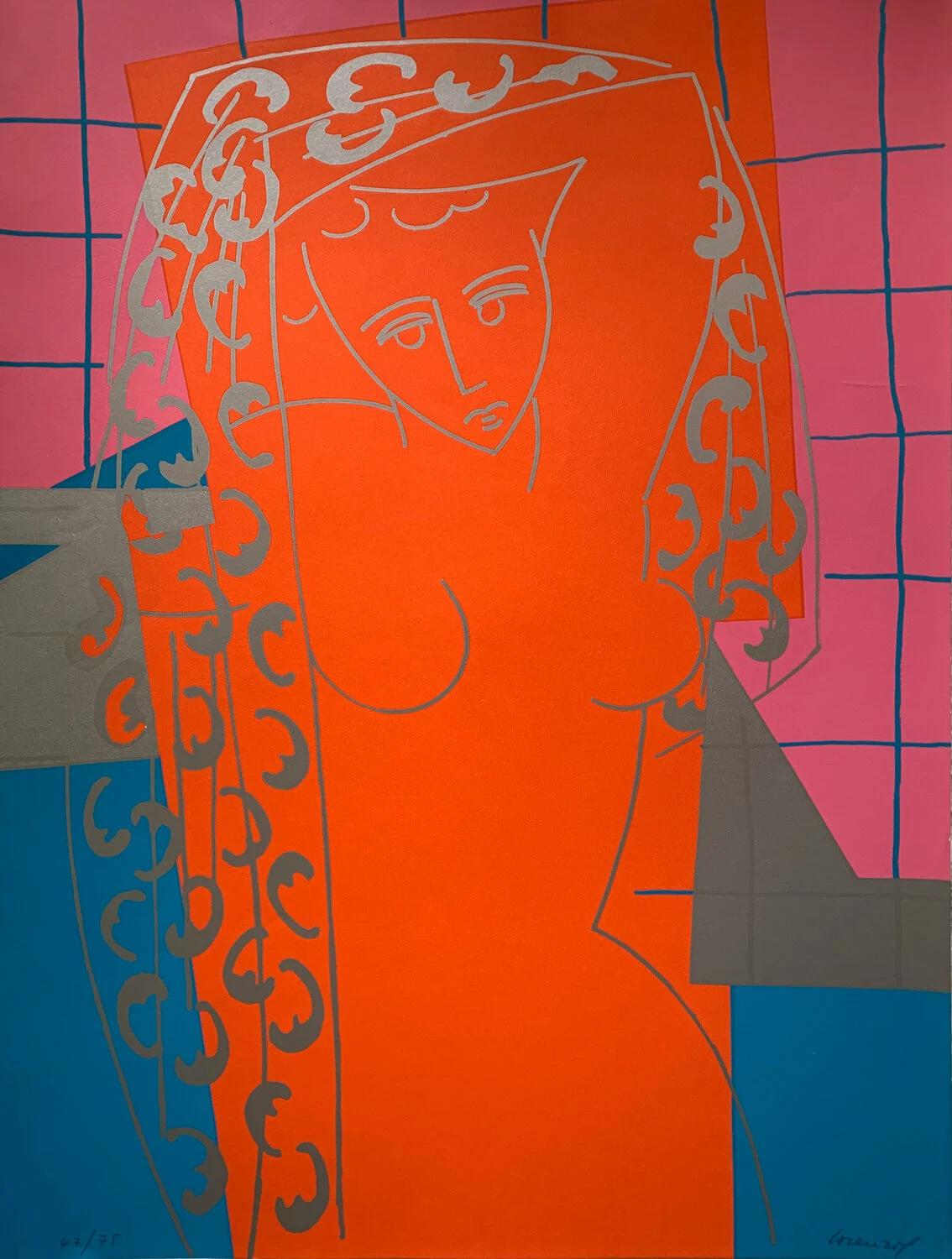
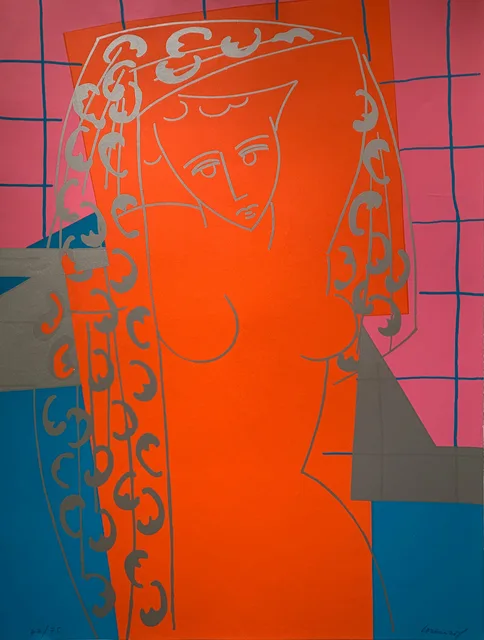
In Cayetana, a large orange field extends vertically. A light line describes the face, torso and curves of a veil. A blue grid over pink, with grey and bluish areas, forms the background.
The comparison with Sara reveals two solutions. Dark lines describe Sara within yellow, brown and grey-green fields; Cayetana’s light drawing remains visible against dominant orange without becoming a continuous black boundary.
The veil’s curves cross the background’s angular order. Regular grid and undulating drawing establish different rhythms, sustaining the figure without constructing a deeply receding room.
Cayetana’s record also lists 100 × 70 cm and 75 numbered and signed impressions. Shared format and edition size do not imply identical ink counts or printing conditions.
What a numbered edition means
An edition is a group of impressions of a print. MoMA’s booklet introduces its relationship to numbering and signature. In a conventional inscription such as 12/75, the denominator states the size of the numbered edition; the numerator identifies that impression within it. The inscription alone does not establish printing order.
Other proofs may exist, but their inscriptions and quantities require evidence for each edition. They cannot be inferred automatically from the main number. A signature seen in a photograph is insufficient to establish authenticity, provenance or condition.
Understanding a particular impression requires technique, dimensions, inscriptions, condition and available documentation. Lorenzo’s catalogue supplies part of this information. An edition of 75 says nothing about how many impressions remain available.
Reading the print as a whole
In Sara, yellow connects arm and head; in Cayetana, a light line sustains drawing over orange. The comparison shows how changes in line, colour area and background rhythm alter the figure.
The graphic work collection brings the prints together. The composition article develops hierarchy and rhythm; figurative painting examines how a few forms preserve recognisability.
Observation exercise: separate plane and contour
Make two small studies of Sara on separate sheets. Reduce one to its main colour fields and retain only principal lines in the other. Note what each study communicates. This is a reading exercise: it cannot reconstruct the print’s screens, inks or printing order.
Sources and references
These sources support the technical concepts. The readings of individual works are editorial interpretations of the linked reproductions.